

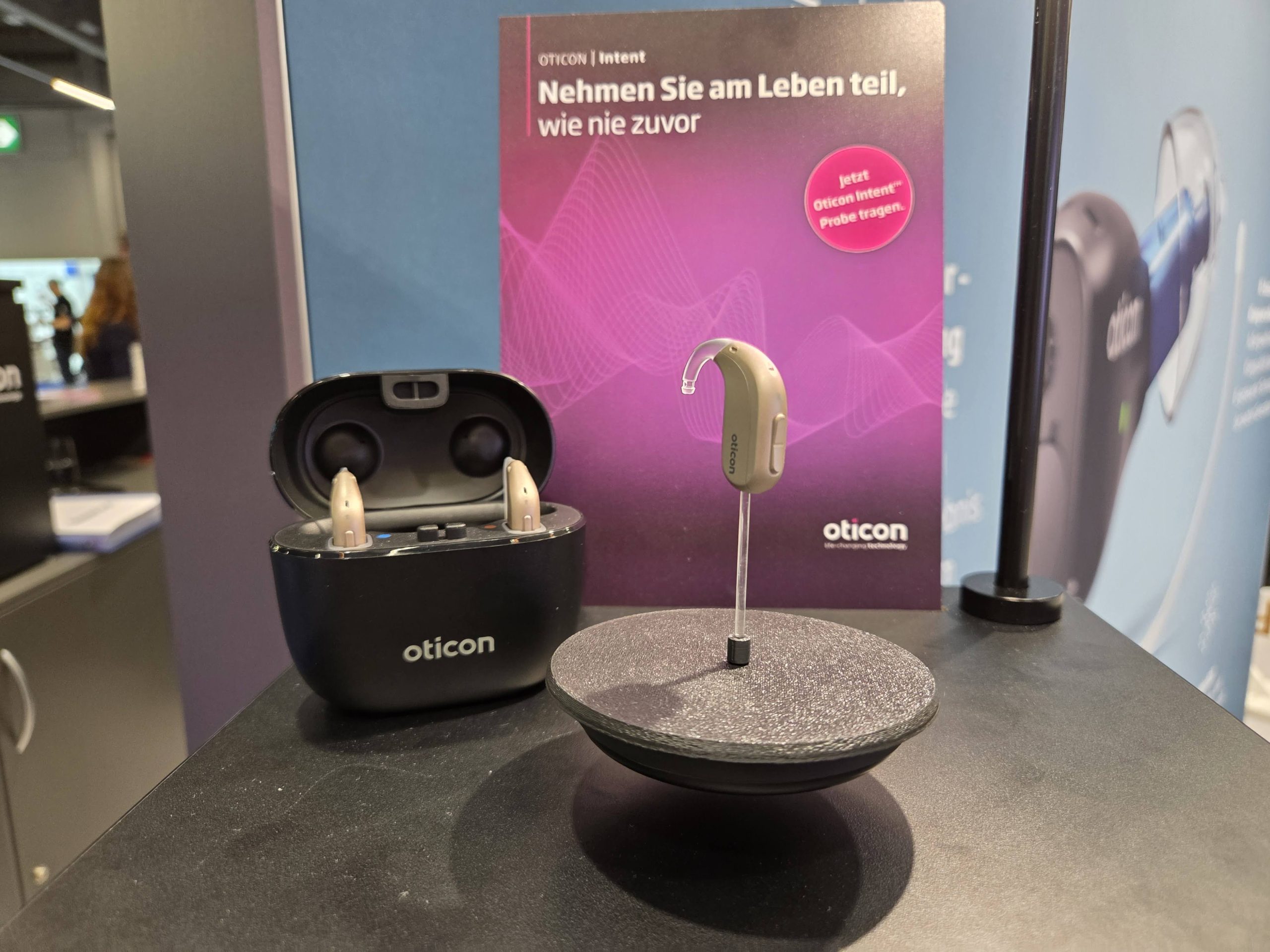
Oticon made a big splash when it joined the Auracast world last autumn. It launched the groundbreaking Oticon Zeal, a discreet in-the-ear hearing aid complete with Bluetooth LE Audio technology, and provided a firmware update to its Oticon Intent range to allow it to take advantage of the technology.
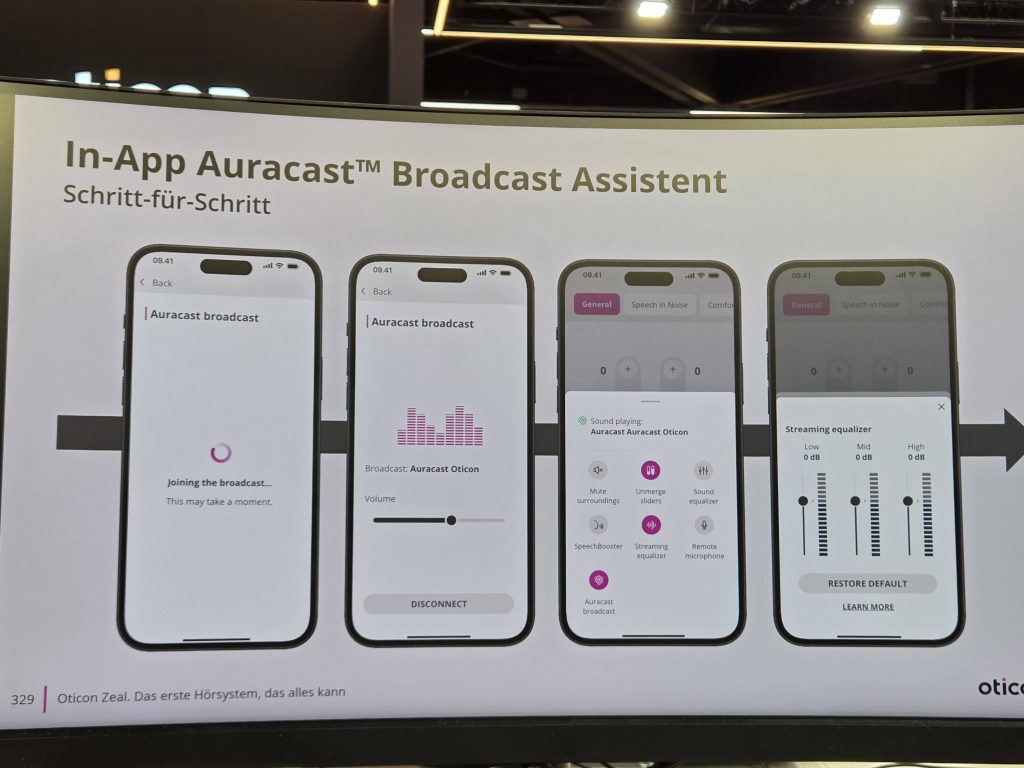
The company ensured its Oticon Companion app was updated to include a built-in Auracast Assistant, ensuring iPhone users were not left behind in the Auracast revolution.
But what is it like?

Oticon supplied us with a review model of the Oticon Intent miniRITE which we have been testing for six months in a variety of situations. We have a severe to profound hearing loss and have been advised that we could be a candidate for a Cochlear implant in the future.
As with our review of the ReSound Vivias, we needed to apply them to a wide range of real-world situations to assess how they cope. It’s important to note that what works well for one person may not for another, and we recommend discussing your options with an independent audiologist who can offer hearing aids from the widest possible range of manufacturers – with trial periods – in order to find the right fit for your ears.
The Vivias and the Starkey Edge AI have custom moulds made, but the Oticons just use silicon domes with the receiver in the ear. This is the same set up as the Oticon Opns that we used to wear, and this has worked absolutely brilliantly.
What is the Oticon Intent?
Originally released in 2024, the Oticon Intent hearing aid is based on the company’s BrainHearing approach: users can hear everything around them, but the aid focuses on what they want to hear. The launch press release describes it as: “the world’s first user-intent sensors which can capture a person’s unique communication goal and then seamlessly provide the brain with the right hearing support in any situation.”
They say this can make a difference in complex listening environments by monitoring conversation activity, head movement, body movement, and the acoustic environment. This approach, they suggest, delivers 35% more access to speech cues compared to the Intent’s predecessor. That’s quite a leap.
Before we started our Auracast journey with Starkey Edge AIs, our hearing aids were the Oticon Opns. At the time, they were the best hearing aids we’d ever worn: the NHS aids we had previously worn couldn’t help in all situations. As a result, we occasionally felt stupid as large chunks of conversations were missed.
The advances in technology over the past 20 years are considerable, and we feel that Oticon is right when it talks about the improvements to speech cues.

One real-world test has been our local pub, a spit-and-sawdust talking shop where phones are banned, the TV is rarely switched on, and the focus is on conversation. It is also a small pub where the majority of customers stand due to a lack of space.
The Oticon Intent has excelled in this situation for one-to-one conversations, correctly picking up the voice of the person speaking to us and filtering out the background hubbub.
Noise suppression … but it takes the brain some time to learn
The Oticon Intent also boasts sound processing from MoreSound Intelligence 3.0, with up to 12dB noise suppression, and a second generation Deep Neural Network (DNN 2.0), which the company says is designed to make the Intent behave more like the brain having learned through experience, enabling better and more accurate representation of sound in the brain and better access to even soft speech sounds in noisy environments.
As regular readers of Aurahear.com will know, we are season ticket holders for Gillingham FC. It’s an old-school football ground with a temporary stand that is so old it deserves listed status.

On matchdays, it can be a noisy place, and initially we found the sound from supporters overwhelming: it was just too loud. Indeed, the first match attended with the Intents was so overwhelming we had to mute the aids. Over time, as our brain got used to the sounds the Intent provided, the DNN got to work. Now, we rarely notice it. Then again, Gillingham barely scored in the tail end of the season, so there was little to shout about.
We do still sometimes turn the volume down.
Connections with the Oticon Intent
The Opns that preceded the Intents had Made For iPhone and, at the time of purchase, would only connect to Android devices and PCs via the ConnectClip. No such issue with the Oticon Intent.
The firmware update introduces Google FastPair, which we wrote about here. This is a quicker way to connect compatible devices: Google says this can include headphones, car kits, mice and keyboards. What makes FastPair particularly helpful is that the settings are stored in the Google Account, so when the two paired devices are in proximity again, they connect automatically.
Essentially, connect once and then forget all about it.
We’ve found this to be the case, as the hearing aids effortlessly remember the devices within our ecosystem. Connectivity can also sometimes be a game of follow the lady – where card sharks on street corners attempt to convince you that it’s an easy win. Instead, it can be frustrating.
But … the aids can sometimes get confused between devices.
Occasionally, the right ear is paired with our laptop, and the left with the phone, or the hearing aids are connected to the computer but won’t stream audio. No amount of fiddling with the settings, crossing fingers, or sternly telling the hearing aids off can convince it otherwise.

At the time of writing, the hearing aids are paired with the computer (right aid only) for microphone and audio. On other occasions, both left and right hearing aids are paired, but the audio won’t play.
As it stands, the Oticon Intels can only stream to one device at a time, and this is one area where the ReSound Vivias have performed better since a firmware update, seamlessly switching between devices. We would hope that a future update from Oticon would give the same flexibility.
Let’s not forget: this is new technology, and these initial teething problems will get ironed out. It may be frustrating, but Microsoft is still getting to grips with Bluetooth LE Audio, and slowly rolling out its shared audio settings.
Similarly, our test phone is a Samsung S25. The connection occasionally drops, sometimes mid-call. Another issue we have had is that sometimes the person on the other end of the line can’t hear you, but you can hear them. There is a Reddit thread where people discuss similar issues.
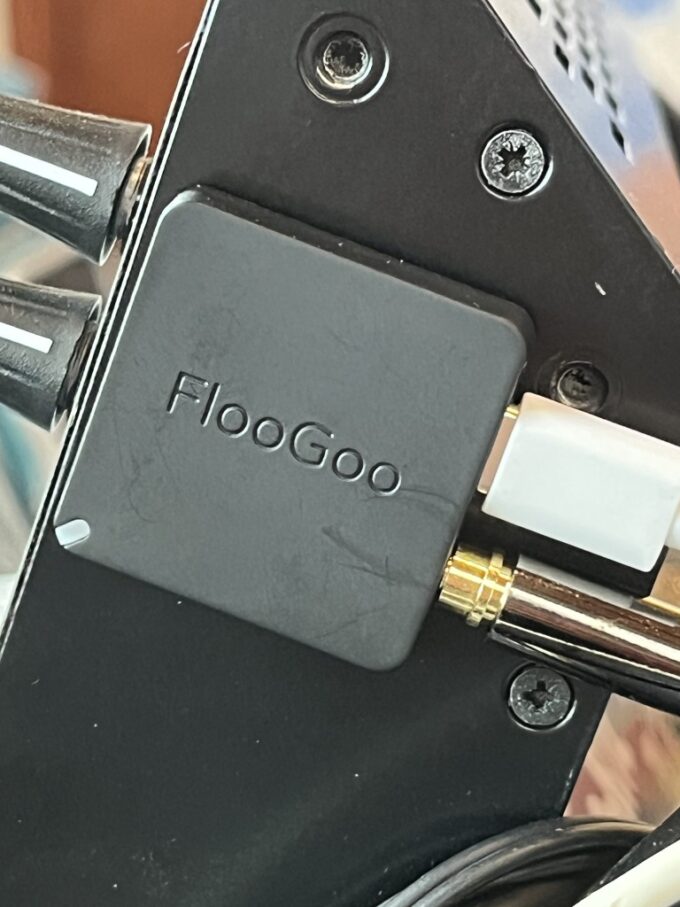
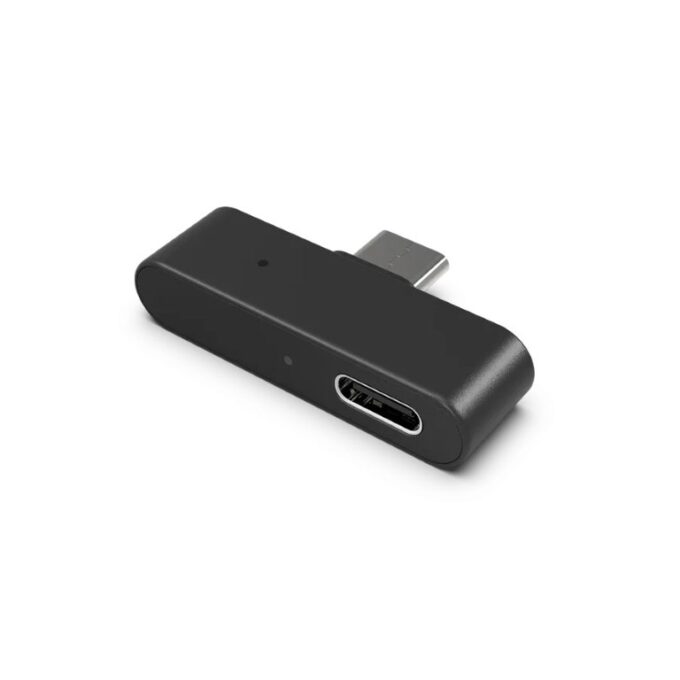
The solution for all these problems has been to use the Oticon Easy LE Adapter, which creates a one-to-one pairing between the device and the hearing aids and is set up to override any other connection. Essentially, it’s an updated ConnectClip but is a physical connection (USB-C) rather than Bluetooth. It also has a USB-C input so it can charge a phone while plugged in.
A full review will appear on Aurahear.com soon.
While these are frustrations, overall, the experience is very smooth and, when we are connected, the sound quality is excellent.
Auracast and the Oticon Intent
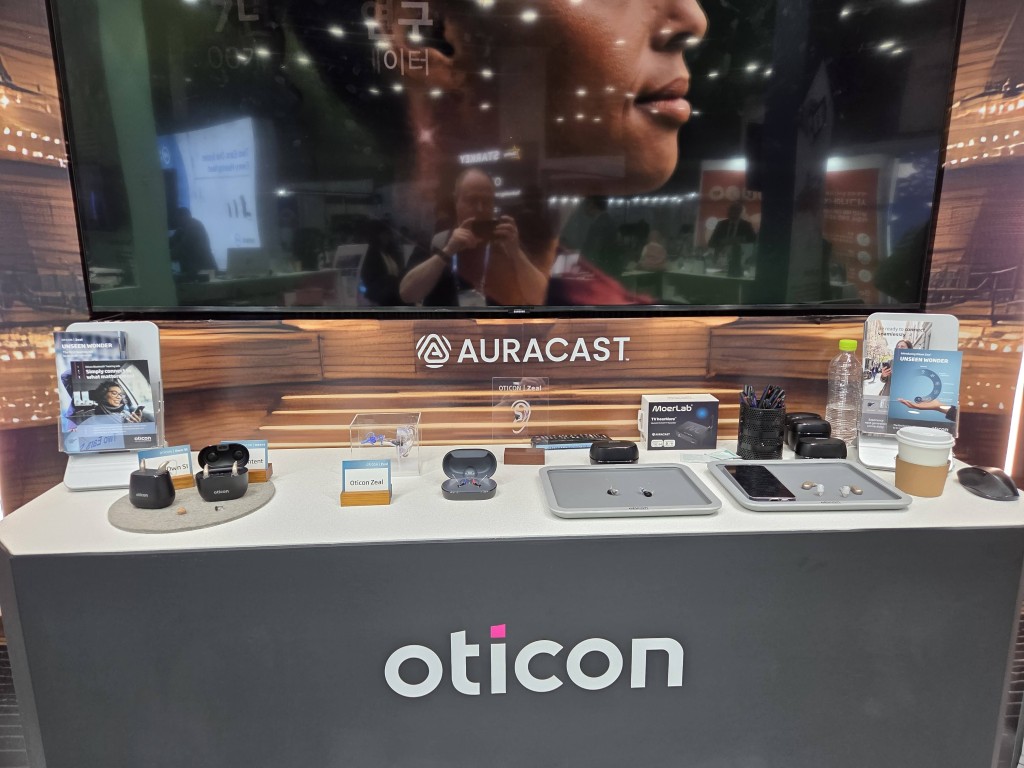
We are delighted that Oticon is committed to including Auracast in its hearing aids. This can be seen in the launches made since the Zeal last autumn: the Verit and the Play, which is aimed at younger hearing aid wearers. We feel Auracast shouldn’t be seen as a premium feature, but as standard in all levels of hearing aids, from NHS basic models through top-of-the-range ones, and Oticon is adhering to this.
The company made connecting to Auracast really easy.
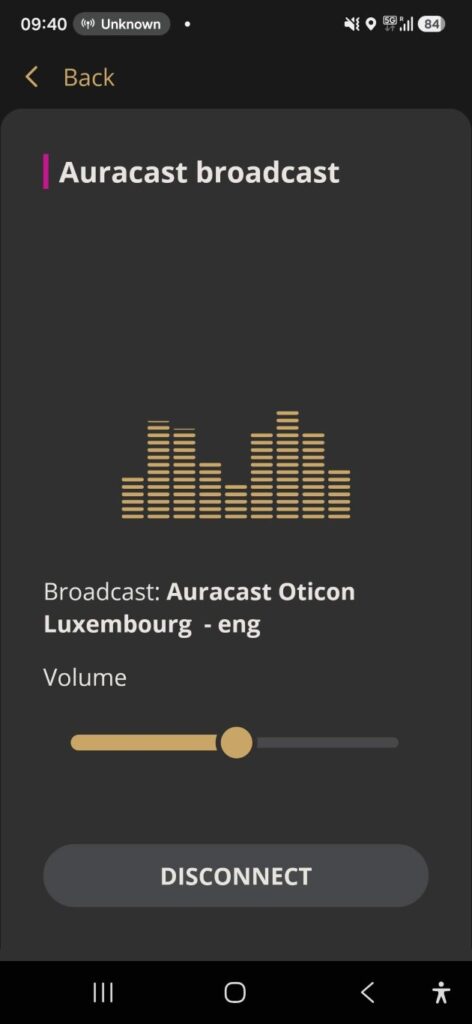
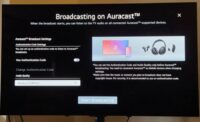
From the Companion app, tap the three dots in the bottom right-hand corner, press Auracast broadcast and you are taken to a screen detailing available streams. It also lets you scan a QR code to connect. One button press and it connects.
Oticon has set up its Auracast so it can take any stream. So if a venue is using a high-quality stream (48kHz) it can still be connected to; it also connects easily to the 24kHz stream. This means users don’t have to worry about a venue’s Auracast, they can have confidence their hearing aids will pick it up no matter what.
This is very satisfying and reassuring.
On the whole, we have had no issues with the Auracast.
Occasionally, the Auracast will arrive in one ear faster than the other, meaning there is a slight echo. This is rectified by disconnecting and then reconnecting.
Otherwise, it is solid, stable and easy to use and the Companion app makes it easy to switch between Auracasts.
Oticon Intent, its MyMusic setting and the 1980 Doctor Who theme tune
When listening to music, there is a special music mode built into the Intents – not just for Auracast.
As big Doctor Who fans, we grew up watching the show in the 1970s and 80s and know the theme inside out, especially the 1980 Peter Howell version. We had a bit of a shock when using the MyMusic setting on the Intents, as the theme sounded very different and we can’t quite put a finger on why. It has more ‘oomph’, with additional reverb and depth, and there are bits that we’ve never heard before.
This has led to some existential questions: have we been hearing it wrong all these years? Given the nature of our hearing loss, this is not beyond the realms of possibility.
In 2022, when launching the MyMusic setting, Oticon said: “specially designed music-orientated signal processing strategies, (it) captures the complex dynamics of music”.
Certainly it sounds richer, deeper and more immersive. It’s definitely a positive experience, but I wish I could go back in time and listen to the original Doctor Who broadcasts just to be sure.
Oticon Intent battery life
As a sealed unit, these are rechargeable hearing aids and now that we have made the switch from throwaway batteries to this new technology we wouldn’t go back. It’s definitely rechargeable all the way.
Lasting around 20 hours on a single charge, we have found the battery life isn’t as good as the ReSound Vivia (up to 30 hours) or Starkey Edge AI (up to 51 hours), but still lasts a full day, even with heavy streaming and Auracast use.
We have had two occasions where the battery life has not been enough. One was the flight from Seoul to London Heathrow: the 14-hour flight across time zones meant staying up longer than 24 hours and the battery conking out halfway home.
The second occasion was watching the World Cup: due to transatlantic time differences, England’s victory over Norway ended with extra time and well into the early hours of the morning. The hearing aids had been turned on shortly after 7am, and by 1.30am, there was 5% charge left. Thank goodness the game didn’t go to penalties.
Both of these are extreme use cases, but the charge is not as long-lasting as other hearing aids.
Essentially, if I’m going somewhere for the day, the charging pot will come too just in case. A 15-minute charge will give four hours of power, which should be enough to get through anything. A half-hour spell in the charging pot gives eight hours, and a full charge is two hours.
Bottom line: the full charge should be sufficient for almost everybody in daily use. But for those looking at extraordinarily long days, such as travelling, a back-up plan may be needed.
And the battery lasts long enough for most people’s lifestyles, while at night they will almost certainly store the Oticon Intent in their charging pots.
Overall verdict
The Oticon Intent hearing aids are extremely good in noisy situations for picking out what you want to focus on – the people that you want to hear and not the ones you don’t. This ensures conversations can be had despite what is going on around you. It’s not perfect; no hearing aid ever will be, but the advances in technology mean these are a significant upgrade on the Opns that preceded them.
Their connectivity via Auracast and Bluetooth LE Audio is brilliant, with the ability to receive any Auracast stream a big step forward. Sorting out the kinks when connected to different devices will be useful, but the Easy LE Adapter will be the solution for most.
If you are looking for a comfortable, future-proof hearing aid that excels in noisy spaces and effortlessly embraces Auracast technology, the Oticon Intent is well worth your consideration.
For more on the Oticon Intent, log on to: https://www.oticon.com/products/663063/oticon-intent-minirite

Aurahear in your inbox!












Leave a comment