

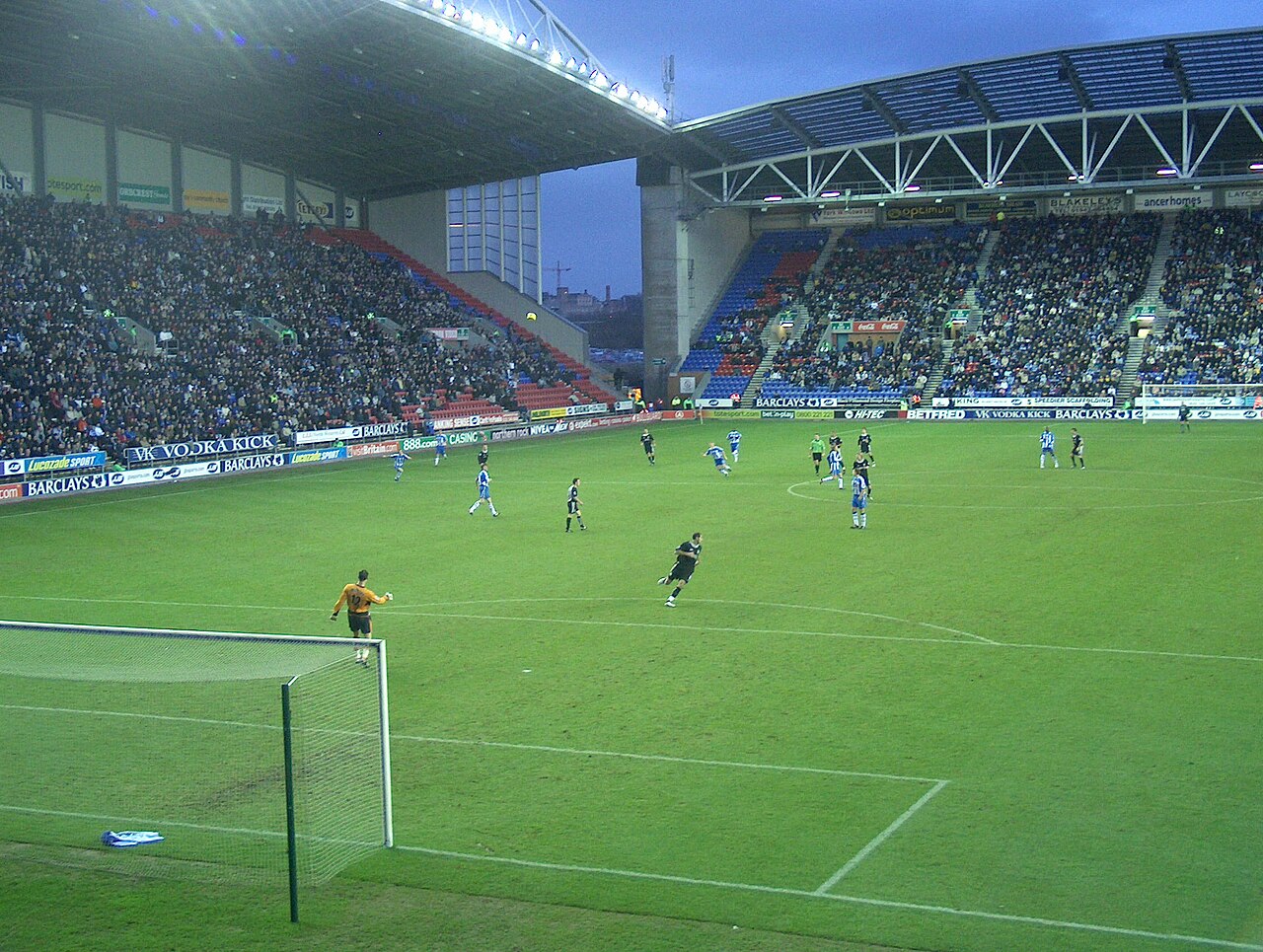
Sports stadiums are the ideal places for Auracast installations: big, open spaces often with infrastructure and stands that date back decades and open to the elements. Hearing anything in them, especially when crowds are chanting, is a challenge.
With transmitters able to cover 100m, Auracast should be an easy win for the home side: a few select installation points, and the whole stadium is covered. The Bristol Temple Meads railway station trial shows it is possible to weatherproof – and bird-proof – the transmitters, while Stadium Taranaki’s TSB Stand in New Zealand shows that Auracast isn’t just a theoretical nice idea, it is a reality.
What can Auracast bring to a stadium?
The matchday announcements can be Auracast: team line-ups, goal scorers, the pre-match music, attendance figures … anything and everything that currently is shared over the Public Address system can be relayed loud and clear.
But there are more ways to make the matchday experience more inclusive.
The first could be to share commentary via Auracast about what is happening on the pitch. Many UK football league clubs have their local BBC radio station give listeners a rundown of what is happening on the pitch, and at a basic level, this commentary could be shared in the stadium.
If the Auracast is set up with multiple channels, home fans could hear their commentary, and visiting fans could pick up theirs, making the experience more accessible for those unfamiliar with the stadium they are visiting.
Audio descriptions: back to square one
When radio was in its infancy, the UK’s Radio Times magazine (so called because it listed the times for radio programmes) featured details of plans to cover what would become Arsenal’s 1-1 draw with Sheffield United at Highbury on 22 January, 1927.
As part of its preview printed a diagram of a football pitch that had been divided into squares, each numbered one to eight.
This was to make it easier for listeners at home to understand where the action was taking place on the pitch – after all, they couldn’t see the action, they could only listen to the commentary. It is said that this led to the phrase ‘Back to square one’ entering the lexicon … because the ball went back to square one.
In essence, this was the world’s first audio description. The commentators knew they had to explain to their audiences what they could not see.
In some ways, it reminds me of the old joke from the snooker contest Pot Black, one of the first colour programmes to be screened on the BBC back in 1969. At the time, very few people in the country had access to the new technology, so the commentator Ted Lowe tried to be helpful: “For those of you watching in black and white, the pink is next to the green.”

Anyway, the i newspaper in the UK published a double page spread in its 18 April, 2026 edition where its chief football writer Daniel Storey spends time watching a game featuring Wigan Athletic with fan Matt Harrison who has macular dystrophy. This means much of his vision is impaired: large black areas in the centre and deep blurring around them.
To see the action, he has to use a small telescope for his left eye. It has a small field of vision, meaning he can only catch some of what is happening on the pitch. As a result, he relies on audio commentary.
Daniel’s excellent article explains that some clubs offer headsets with general commentary and an audio description, the latter providing a frame of reference.
“Matt needs to know where the ball is … He needs to know where passes have been directed. Good radio commentary contains deliberate periods of silence but, for Matt … silence is darkness,” he writes.
But there is a problem: “The audio commentary cuts out occasionally and dips in volume. Matt’s batteries run out”. Thankfully, replacements are included in the kit bag.
The article highlights two clubs doing it right: Cambridge United are said to have the best audio description, while Nottingham Forest saw stewards bring the equipment to Matt’s seat. It also talks about clubs where Matt’s experience has been sub-optimal: dead batteries and no replacements, stewards who don’t seem to care or understand, and being asked to sit in the wheelchair area rather than with friends and family.
Daniel adds: “I can’t quite believe it when (Matt) tells me there are EFL clubs that do not offer the service. Matt has been in away ends … with nothing to assist him”, a situation he says is “a scandal that must be addressed”.
We agree with Daniel that “Every professional football club in England must provide a full audio description commentary”.
Auracast offers a clear way forward
Daniel points to a “far more ambitious and optimistic” future, noting that Crystal Palace and Dundee United have trialled headsets with no latency issues. It doesn’t say whether these are Auracast, but the description suggests they could be.
He also highlights a Japanese invention, an ‘AI suitcase’ that can track the ball and vibrate to indicate its location.
A third suggestion is that a 5G phone network could be made robust enough to avoid delays: the problem is that in a stadium with thousands of people, demand on those cellular networks would be immense.
Auracast will have an advantage here because it operates on a different frequency than the 5G signal or a WiFi network. For the user, that means there is no need to worry about using up data to access it. For the venue, it places less demand on its infrastructure, especially since Auracast systems can be added to existing AV desks. It is a quick and easy way to ensure that clubs can make the beautiful game accessible to as many people as possible.
This year’s season is nearly over (as a Gillingham fan, the end can’t come soon enough). It’s entirely possible for a football club to take action now and have an Auracast system in place for the start of the next season in August. Multiple channels would allow for accessibility and a matchday experience that works for as many people as possible, regardless of where they sit or stand on the ground.
Daniel’s article can be read here: https://inews.co.uk/sport/football/wigan-athletic-watching-football-blind-fans-4224814















Leave a comment